API intelligence platform / Live
Reqistry
A platform for discovering, comparing, monitoring, and connecting APIs and MCP tools, for engineers and AI agents.
- Role
- Product owner and engineer
- Period
- Ongoing
- Status
- Live
- Stack
- TypeScript, Fastify, Next.js, PostgreSQL
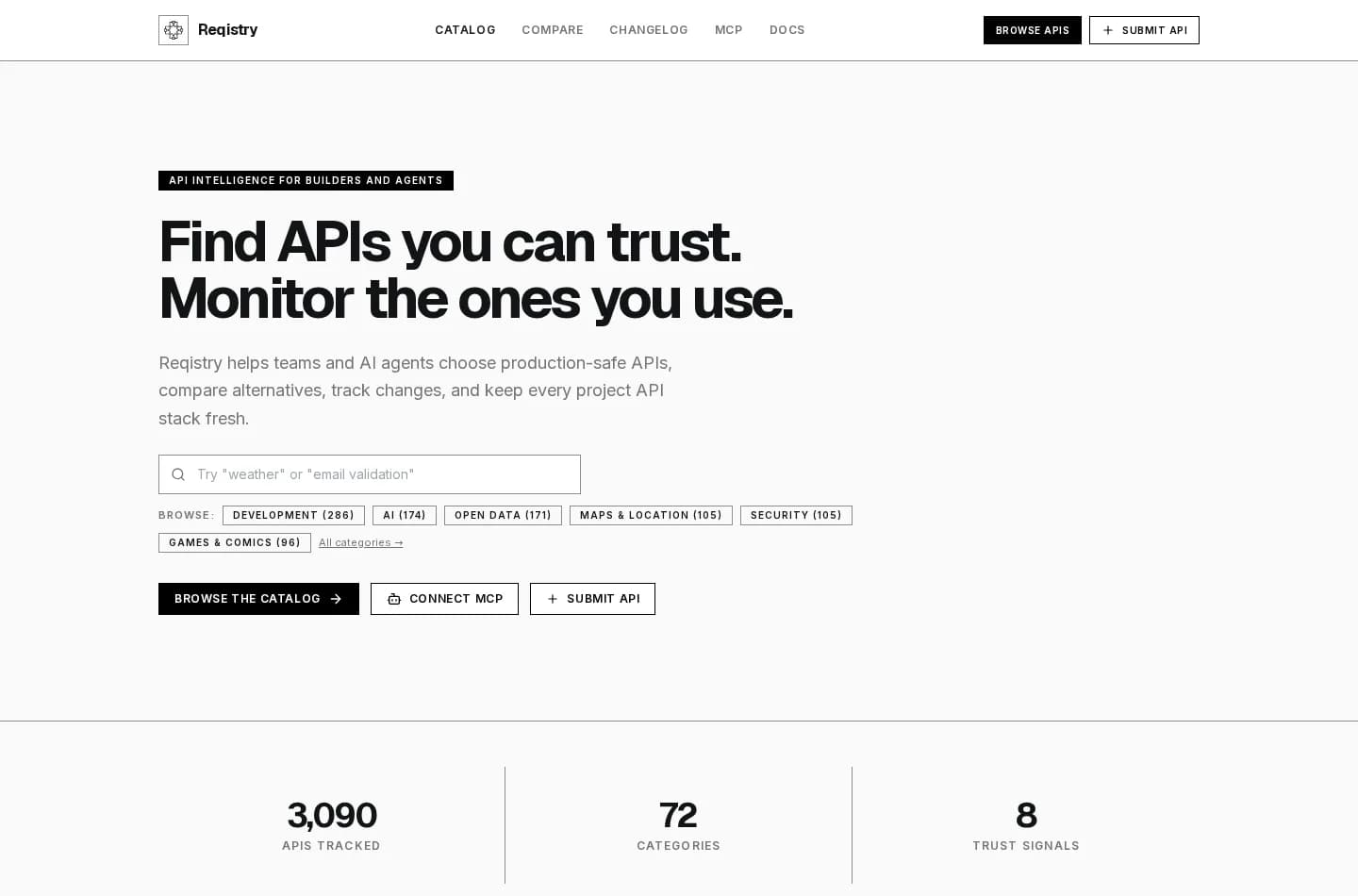
3,090 APIs across 72 categories tracked on 28 October 2026
5K+ Google Play downloads, 4.6 rating from 66 reviews
16 MCP tools served over streamable HTTP
The problem
API directories answer one question: what exists. They rarely answer the questions that decide whether software ships: Is it alive? Is the authentication model clear? Is CORS supported? Is the pricing current? Did anything change since last month?
Reqistry treats those as first-class data. The product is designed to help a developer, a team, or an AI agent choose an API with evidence and understand when that evidence changes.
What the product does
The catalog is searchable and categorized. Each profile combines catalog facts with live platform observations, and every surface reads from the same backend.
- Search and filter 3,090 APIs across 72 categories
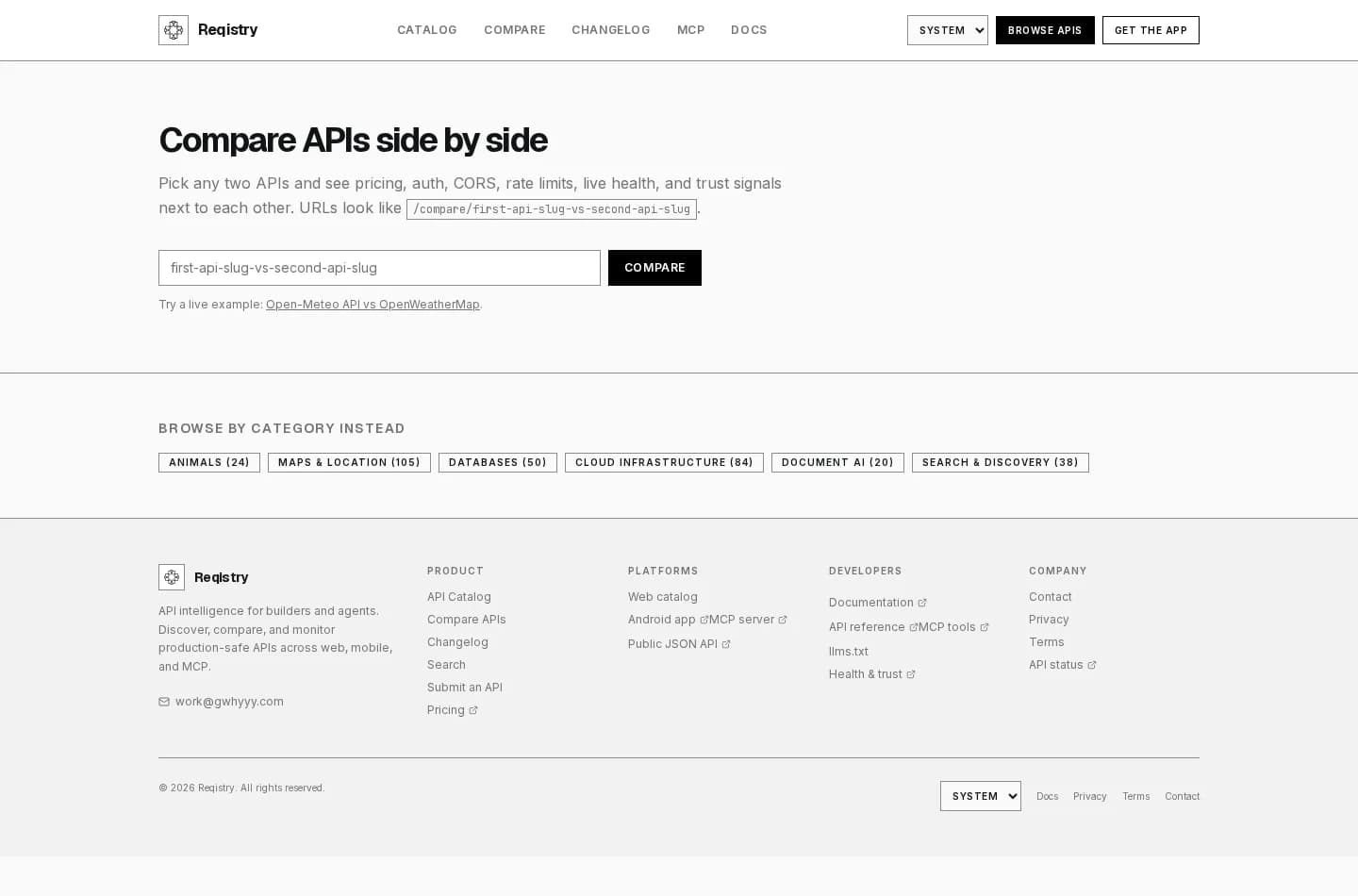
- Compare 2 to 8 APIs on pricing, auth, CORS, rate limits, health, and trust
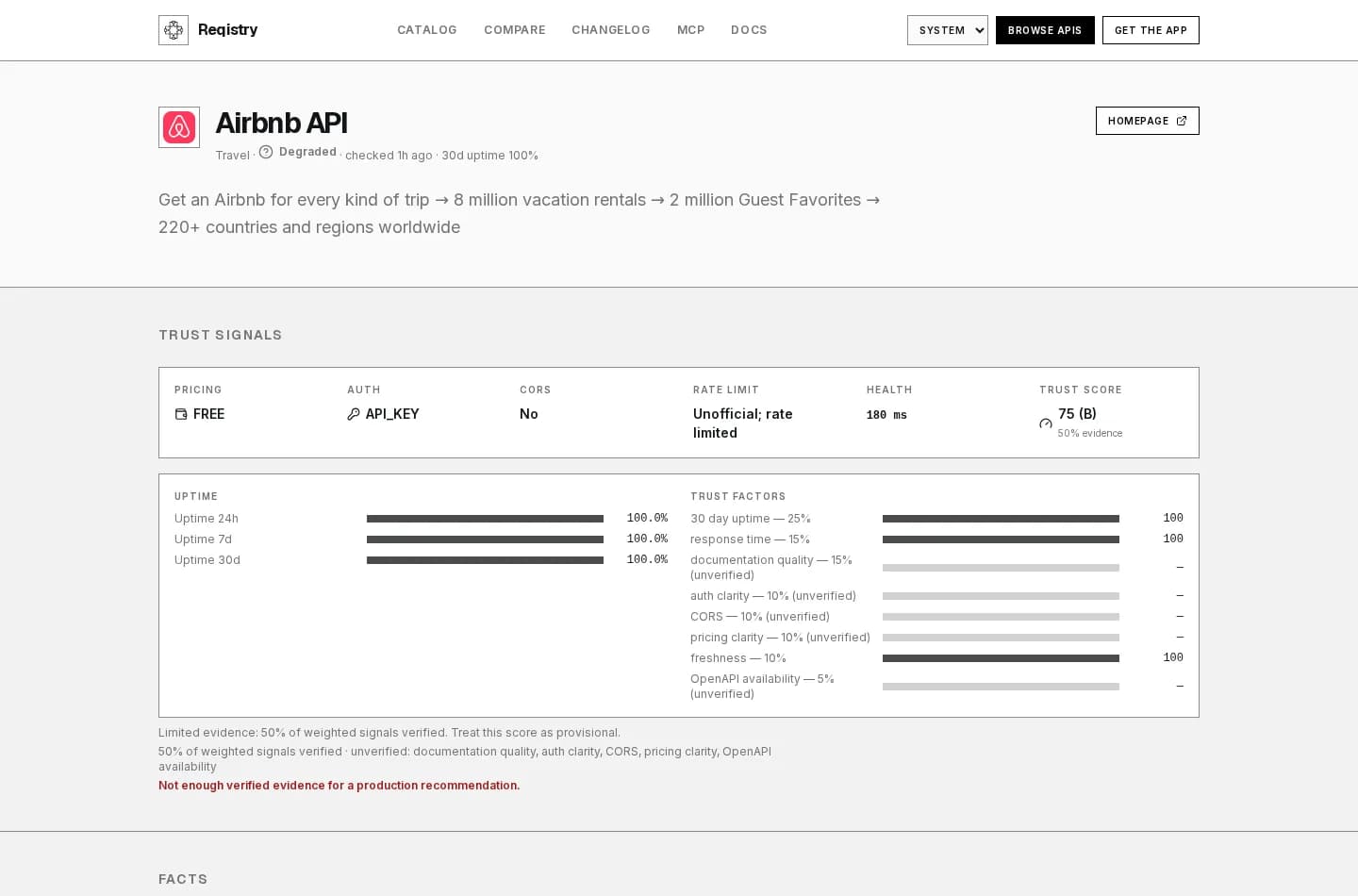
- Trust scores built from eight weighted factors, with confidence and unknown signals exposed
- Change feed for health, pricing, documentation, and trust events
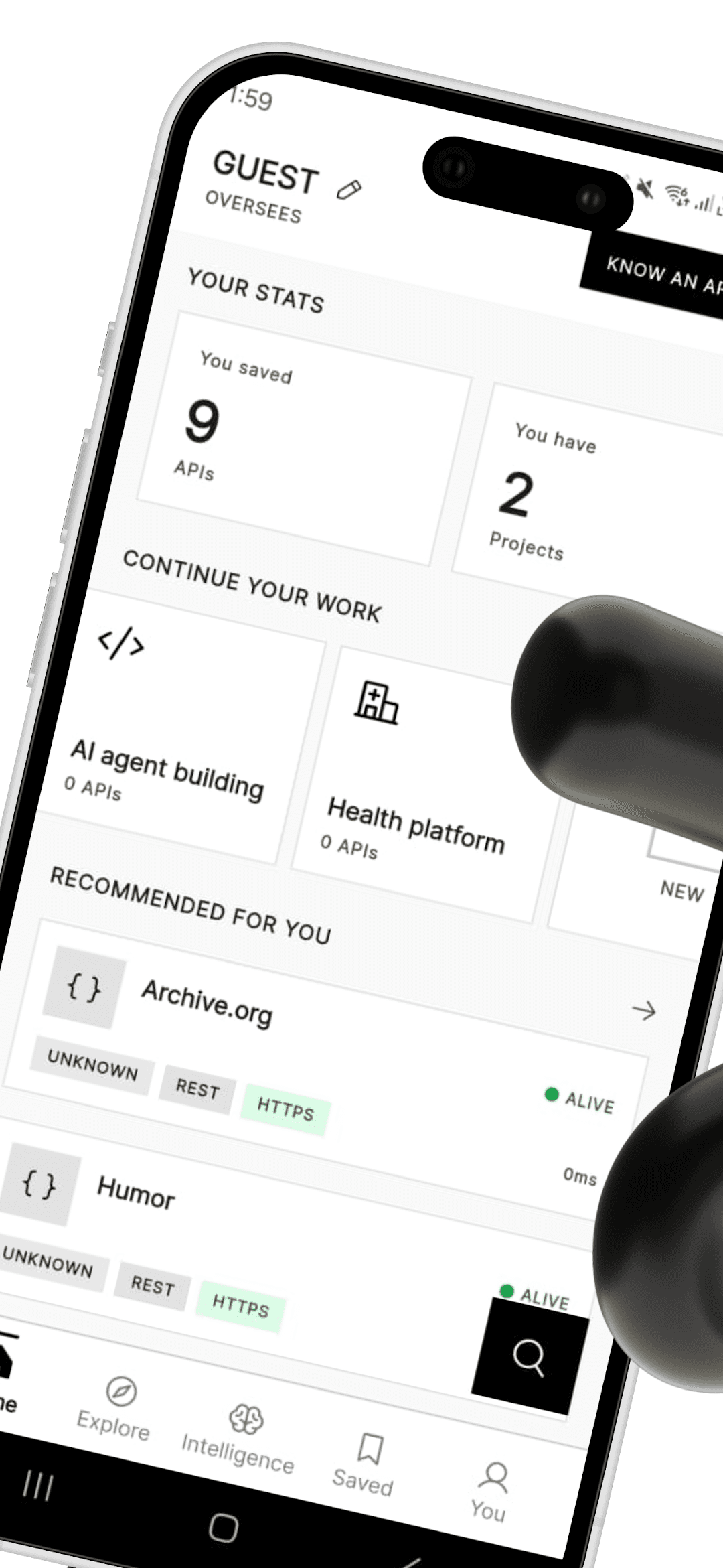
- Projects, saved APIs, watchlists, and daily digests in the Android client
- MCP server for agents to search, compare, assess safety, fetch snippets, and submit APIs
How the system works
A Fastify API serves the web app and the legacy mobile contract. PostgreSQL is the source of truth; Redis handles caching and queues. A BullMQ worker performs the slow, continuous work: probing endpoints, refreshing metadata, recomputing trust, creating change events, and sending notifications.
The MCP server is a separate service over the same API. It is stateless per request, supports agent keys, and returns the same catalog evidence a human sees. That shared contract is what keeps the product coherent across web, mobile, and agents.
- Hourly health probes with consecutive-failure tracking and 24h/7d/30d uptime
- Non-probative targets are marked unknown instead of falsely alive
- Six-hourly metadata and trust refresh
- Change events drive the changelog, mobile notifications, and admin alerts
- Rate limiting, API keys, sessions, audit logs, and request logs on the API
Engineering decisions
The most important product decision was to make uncertainty visible. A trust score with missing factors should not look the same as a verified score. The scoring model excludes unknown factors, computes confidence from the known weight, and reports which factors are missing.
The second decision was to keep one evidence pipeline. Web, Android, and MCP do not maintain separate truth. They read the same API data, so a health event or pricing change appears everywhere it matters.
- Evidence and freshness over a single opaque ranking
- Eight factors: uptime, response time, docs quality, auth clarity, CORS, pricing clarity, freshness, OpenAPI availability
- Stateless MCP transport with read tools open and consequential tools authenticated
- Safe fetch with SSRF protection for metadata collection
- Backups every 12 hours and an operator audit trail
Android and distribution
The Android client is published under Gwhyyy on Google Play. The public listing documents discovery, trust signals, comparison, watchlists, projects, submissions, and agent-key connection. The store reports 5K+ downloads and a 4.6 rating from 66 reviews at the time of this audit.
This case study focuses on the web, API, worker, and MCP surfaces that were reviewed directly from source. Client implementation details are not published because the Android source was not available for this review.
Verified results
The numbers below are public or reproducible from the source tree. They are dated because catalog counts and store metrics move.
- 3,090 APIs and 72 categories on reqistry.dev, 28 October 2026
- 5K+ downloads and 4.6/66 reviews on Google Play, 28 October 2026
- 16 MCP tools, 45 Prisma models, 48 test files, 115 commits in the reviewed repository
- API, PostgreSQL, and Redis healthy at api.reqistry.dev/health, 28 October 2026
- Docs canonical/robots cleanup remains an open follow-up; it is not claimed as fixed
What I owned
- Product design and feature definition
- Next.js web platform: catalog, search, compare, changelog, submissions
- Fastify API, PostgreSQL schema, Redis caching, and authentication
- BullMQ worker: health probes, metadata, trust scores, alerts, backups
- MCP server with 16 tools for API discovery and production-safety checks
- Operator dashboard and production release engineering
Verified evidence
- 3,090 APIs across 72 categories tracked on 28 October 2026
- 5K+ Google Play downloads, 4.6 rating from 66 reviews
- 16 MCP tools served over streamable HTTP
- 8 weighted trust factors with explicit unknown state
- 45 Prisma models and 48 backend test files
- TypeScript
- Fastify
- Next.js
- PostgreSQL
- Prisma
- Redis
- BullMQ
- MCP
- Flutter
Related services
Mohamed Anas Fikhi / Casablanca, Morocco
Have a similar problem?
Describe what you are working on. I will tell you whether I can help and what a sensible first step looks like.